
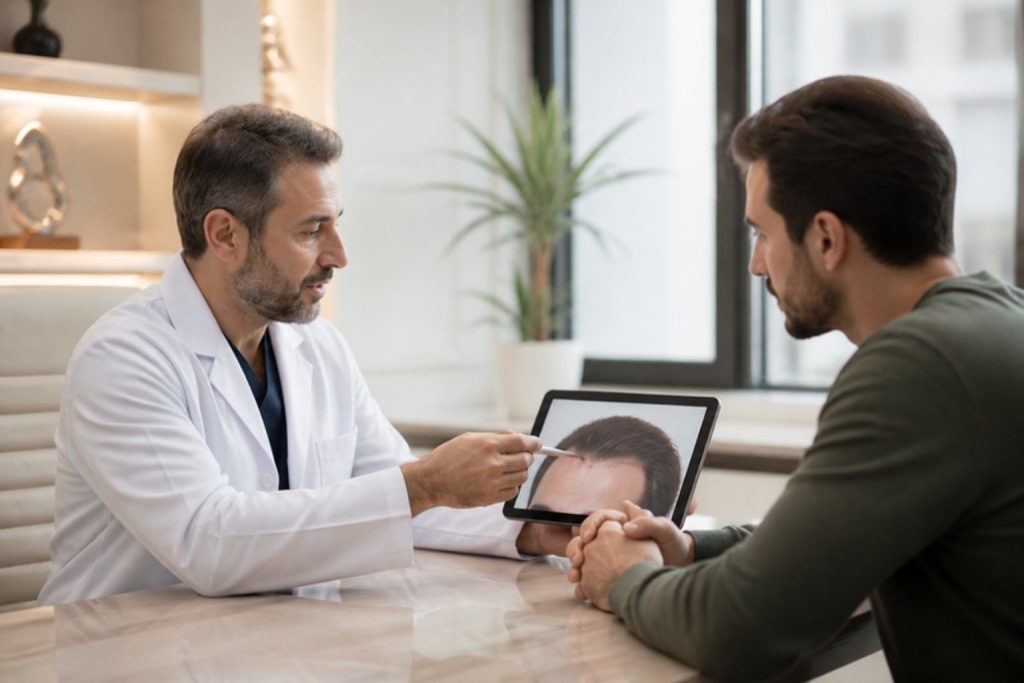
When hair transplant clinics look for a marketing agency, most of them ask the same question: “How many leads can you bring us a month?” But the number of leads on its own says very little. The real question is how many of those leads turn into consultations and procedures. In this article we explain what to look for when choosing an agency, which questions to ask in the first meeting and which warning signs to avoid.
Short answer: The right marketing agency for a hair transplant clinic has real case studies from hair transplant clinics with numbers it can show, knows the language and the patients of the country you target, cares about how leads are handled after the ad, measures success in consultations and procedures rather than lead counts, and opens the ad accounts in the clinic’s name.
Why hair transplant advertising is different
A hair transplant is a high-value procedure that patients think about for a long time. Many patients come from another country and expect fast, reassuring communication in their own language. They send photos before they get a price and talk to several clinics at once. That is why in hair transplant marketing half of the work is the ad and the other half is the conversation that follows it.
There are rules, too. Clinics in Turkey may not advertise to people living in Turkey, while promotion aimed at patients abroad is allowed under specific conditions; we cover this in Can doctors advertise in Turkey? Markets such as Germany and the UK have their own rules as well. An agency that does not know them can get your ad account restricted.

7 things to look for when choosing an agency
1. Real case studies from hair transplant clinics, with numbers
“We have worked with many clinics” is easy to say. Ask for case studies that show the market, the period, the cost per lead and the rate of leads that turned into consultations. The clinic’s name may be confidential; the numbers should not be.
2. The language and the patients of your target country
A patient in Italy is not looking for the same thing as a patient in Germany or the UK. A good agency builds the ad around the treatment in demand in that market and in that country’s language, not around a generic “hair transplant” message. Ad copy and videos should be in the target language.
3. Caring about what happens after the ad
Most leads are lost in the first message, not in the ad. A reply that comes late, is not in the patient’s language or ignores the treatment they asked about does not start a conversation. The agency should look at the first reply time, the WhatsApp flow and whether leads are tracked in a CRM. In this case study we show how a hair transplant clinic in Tirana raised its reply rate from 10-12% to 70% just by fixing the communication.
4. Measuring consultations and procedures, not just leads
A cheap lead is not always a good lead. Alongside cost per lead, the agency should be able to report cost per consultation and cost per procedure. That requires the ad account, the website and the CRM to be connected (Meta Pixel and Conversions API, Google Ads conversion tracking and similar).
5. Ad accounts owned by the clinic
The ad account, the Facebook page, the Instagram account and the pixel should be opened in the clinic’s name, with the agency only given access. If you part ways with the agency, your history and your accounts stay with you.
6. Knowing the rules
Turkey’s health advertising rules, Meta’s ad policies on health and appearance, Germany’s HWG and the UK’s ASA rules, for example. An agency that does not know how to use before-and-after photos can get your ads rejected or your account restricted.
7. Transparent fees
The agency fee and the ad budget should be listed separately, and the ad budget should be paid directly from your own card. What you pay for, how many creatives are produced each month and how often you get a report should be clear from the start.
8 questions to ask in the first meeting
- Which countries have you run hair transplant ads for?
- In one of your case studies, what were the cost per lead and the consultation rate, and in which period?
- In which languages do you produce ad copy and videos?
- Do you look at the first reply time and the WhatsApp flow after a lead comes in?
- Will I see consultations and procedures in the report, not just leads?
- In whose name will the ad account and pages be opened?
- How many new creatives do you produce each month, and what is your testing plan?
- How do you follow the health advertising rules of Turkey, Meta and the target country?
Warning signs to avoid
- A guaranteed number of patients: Nobody can guarantee how many procedures you will get. An agency that does is either presenting leads as procedures or not telling the truth.
- Ad accounts opened in the agency’s name: When you leave, you lose your data.
- Reports with lead counts only: If consultations and procedures are not visible, you cannot tell what works.
- The same ad for every country: The same copy and visual do not work in every market.
- One creative for months: Ads wear out and costs rise.
- A long contract with no way out: Do not commit for a long period before you have seen results in the first months.
What does a hair transplant lead cost?
It varies a lot by market, treatment, creative and season. Two examples from our own case studies:
- Tirana to Italy: €3-4 per lead between July and September 2026. (case study)
- Germany, 40 km around the clinic: €6-9 per lead; the first reply time fell from 3 hours to under 1 minute and lead-to-consultation rose from 15% to 21.9%. (case study)
These figures give you an idea, but they are not a forecast for your clinic. What really matters is the total ad cost per procedure.
How Novera Media works with hair transplant clinics
Since 2018 we have worked with hair transplant and dental clinics in Turkey, Albania, Kosovo and Germany. We run campaigns that bring patients from Italy, Germany, the UK, the Balkans and West Africa. We build the ads, the clinic website and the CRM where leads are tracked in one team, so the path from the ad to the consultation stays in one place. We also built Sodo CRM, which brings leads from WhatsApp, Instagram and Meta lead forms into one screen.
How we meet these 7 criteria
- Case studies with numbers: 3 published case studies from hair transplant and dental clinics, with period and measurement notes. €3-4 per lead from Italy; 21.9% lead-to-consultation in Germany.
- Language and market: Ads in Italian, German, English and Albanian; separate market work for Italy, Germany, the UK and the Balkans.
- After the ad: Leads go straight into Sodo CRM; with an automatic welcome message the first reply comes in under 1 minute.
- Measurement: Leads, consultations and procedures are tracked in the CRM, and the stages are sent back to Meta through the Conversions API.
- Accounts owned by the clinic: The ad account and pages are opened in the clinic’s name; we work with access only.
- Rules: We work within the rules of Turkey, Germany (HWG) and the UK (ASA) and explain them on our market pages.
- Fees: The agency fee and the ad budget are separate; the ad budget is paid from the clinic’s own card.
We explain how we work on our hair transplant clinic marketing page, show our results in case studies and cover the target markets on the Italy, Germany and UK pages.
Frequently asked questions
Meta or Google for a hair transplant clinic?
For most clinics the starting point is Meta (Instagram and Facebook), because you can catch a patient’s interest with photos and video before they start researching. Google catches the moment when a patient is already searching for “hair transplant”. Using both, according to the budget, usually works best.
How soon will I see results from an agency?
The first leads usually come a few days after the ads go live. To see which creative and which market works, you need a test period of at least 4-8 weeks. Because the decision to have a procedure takes longer, the real result becomes clear in 2-3 months.
Are ads alone enough?
No. If leads do not get a fast reply in the patient’s language, even the best ad is wasted. Ads, the first reply and follow-up should be planned together.
Does the agency talk to patients on the clinic’s behalf?
It depends on the agency. We leave the conversation to the clinic’s sales team and set up the message flows, saved replies and CRM so the team can reply quickly and correctly.